Showing posts with label reader's digest. Show all posts

Saturday, June 28, 2008

'build it like zaha'

Interview with Patrik Schumacher


You just compared what you are doing to the work of the early Modernists; what is Zaha Hadid Architects giving to architecture? If people look back in future, what would you hope architectural historians would say you have achieved?

It’s a good question. I sometimes look back at 5,000 years of architecture and try to see what… from found spaces like caves, to the first moments of architecture – the introduction of geometry, in Egypt, in Greece. And it crystallises. Then you go on to Rome. In Greece and Egypt they established a single geometric significant piece: a collonade, a certain crystal. And in Rome you have a typology that develops into multiple organs of a complex system, and they introduced one more technique, which is vaulting. And then there is not much else until the renaissance, until Baroque; curvilinearity.

Actually the baroque is interesting because it brings continuity between pieces. The renaissance was pushing platonic bodies into a proportioned ensemble, but each of them was an autonomous piece with its own symmetry. The baroque for the first time breaks the symmetry of the original piece and they become radicals, so you build up a kind of global complexity. So they become larger complexes that are drawn together and unified.

This is interesting but then there’s not much going on really until Modernism. Eclecticism and Historicism are just kind of trying to cope with the new complexities in an unconvincing, uncompelling way, an artificial way. To kind of… you suddenly have the Modernist period, which works on the notion of space. Composition comes into its own; before it was just about redesigning a given type – a palace, a villa. Even if you use it for other things, it’s a certain organism. You are not bringing things together; you are not trying out random arrangements.

So composition is something very late; and we still do that. Looking back on history shows you that the game of what it is to design changes radically. Before it was just reproducing a type; then suddenly you can compose, which is quite outside the previous thinking. And we have these kind of breaks in the 20th century. For instance It’s very important this idea that you’re not only composing elements in an arrangement to make a composition.

There are two things: one is the interpenetration of the elements; you compose a site, then you compose it again in this layered way. You build up intricacies. This is radical, this is unheard of. It’s a major thing. Zaha was involved at the beginning. This is something that you could say is a strong and new paradigm in the late 20th century.

But also this idea of going from composition, which involves a number of parts, to a field, which is made up of particles, none of which has a name or a number or an identity. It’s only the field effects and qualities that matter; the particles are just fragments of a global mass. This is a totally different attitude, a different way of handling things; it’s not about composition, because we don’t care about any of [the individual elements]. It’s just a drift; the distribution, the directionality, the intensities you have; there’s a looseness. And so that’s something we’ve been involved in pushing.

Also the lawfulness of a composition, where you just make sure that the line, the hand, has a law and a trajectory, but it doesn’t give you a shape; it doesn’t have a front and back. It’s a new ontology of what you consider to be an environment. And then you realise it’s nature-like. These are major breakthroughs. This notion of field – like our Rome museum – it not something you have an image of. It’s not something you hold onto like an object but something you immerse yourself into and you follow certain laws of proliferation. You’re drawn through it.

These are major contributions that you can then bring to urbanism. So you can now give an order to an urban area that isn’t like the kind like the gods’ top view with a clear boundary and three parts, but a field logic.

This is a fundamentally new type of thinking I think which pertains to urbanism and large buildings. It has a lot to do with the late 20th century, where cities totally grow out of that comprehensible thing, where you can grasp and know whether you’re in front, in the middle or behind. So these new sensibilities have a lot to do with new social processes and the way life operates on the planet.

Thursday, May 01, 2008

Scar Tissue - Marko Zlomislic


Scar Tissue
===========

Marko Zlomislic


Cinema means pulling a uniform over our eyes, warned Kafka
-- Paul Virilio, _Open Sky_


You are taken to see but your eyes are not prepared to
look at the spectacle placed gently in front of you
like a birthday cake.

It is the dead who blow out the candles as your
illusions are cut into pieces.

The dead devour what still lives even as we eat
the recycled remains of what is planted in the field,
delivered to supermarket spouting forth freshly sprayed.

To live on as one of Prometheus' children. Shreds of
his liver torn by the eagle to re-grow. We are his
scar tissue.

The sweep of the broom over polished concrete
stepped on by a million daily commuters, mute
and unthinking, blind to the little
pleasures as they search for the nuclear fusion
of the orgasm afterglow.

A shoulder to sleep on as your head is cradled.
But there you already feel the skeleton underneath
the varnished skin dying to leap through tissue,
sinews, frayed nerves and muscle.

The little acts of revenge are sweet especially
when you have a key to the Other's door.
Declare a war against vending machines and
parking meters. Fill their slots with Chuck E.
Cheese tokens. The Real seeps in through the cracks
of the imagination to leave its stain.

Left on the doorstep, a letter, a video,
a dead mouse; all brought as a gift.
These do not satisfy your hunger.

On TV a horse takes the lead in the
Tour de France. A preacher plays the
electric guitar for Jesus who is still
smoldering on Golgotha.

It is a fun house ride with death hitching
on your admission ticket.

Magnify the details to bring the disaster near.
Cut and paste until you create the ideal
Adobe view. Where and when will we meet?

We seek order where chaos rules.
The bits are packaged: salad, porn, apples,
cuts of meat, coffee spoons.

The light enters when the illusion becomes tired.
The cliche, "I love you" should be returned
with silence. The echo you seek is an old repetition.

The knock on the door, the ringing of the telephone
are all
reminders to stop eating the remainder.

How is this possible when Death nourishes what survives?


--------------------

Marko Zlomislic is professor of philosophy at Conestoga College, Institute of Technology and Advanced Learning in Kitchener, Ontario. He has recently published _Jacques Derrida's Aporetic Ethics_ with Lexington Books and is currently writing a critique of Slavoj Zizek's work.

Monday, February 25, 2008

blow up a-go-go

trip reading - a year in the life of andy warhol

Solipsism, the theory that only one mind exists and that what appears to be external reality is only a dream taking place in that mind.

Thursday, July 12, 2007

curzio malaparte - casa come me


sounds like sea and a volcano seen from the balcony :)
just like napoli

"Casa Malaparte, as the artists who have used it as backdrop have immediately grasped, is architecture in the service of the imagination. It is architecture for the loner who dreams a specific dream about power. This has nothing to do with the notion of the house as a social necessity and as a testing ground for improved construction techniques, such as envisaged by Libera in 1941: `We must deny the family house any character as art, and claim its aesthetic and human character.' Curzio Malaparte and his Capri architect have designed a three-dimensional object that can only be fully appreciated from a distance. Close to, one sees only the details; the architecture disappears from sight. From the inside it is impossible to make any connection with the exterior and vice versa. In practice, however, the occupants who walked over the geometric skin of this architectural `body' or looked out through its eyes, experienced a stimulating incorporeality. This architecture is about crossing boundaries and about surrender. Not surrender to nature or society, but to the domain of the artistic individual: the imaginary and its images."

Wednesday, July 11, 2007

Motherland by Simon Roberts

Abandoned warship in the Kola Bay. Murmansk. Northwestern Region, January 2005

Yevgeny Chavkin. Ulyanovsk. Volga, June 2005

The lounge of a former sanitorium. Sludyanka. Eastern Siberia, November 2004

Ballroom dancers, Nikita and Rufina. Omsk. Western Siberia, May 2005

Zhenya and his pregnant fiancée, Mia. Yakutsk. Eastern Siberia, November 2004

Port officials. Vladivostok. Far East Russia, October 2004

" Roberts and his wife traveled throughout Russia between July 2004 and July 2005, making pictures in over 200 locations and creating one of the most extensive, comprehensive photographic accounts of this vast country by a Westerner. "

Thursday, July 05, 2007

fragmente

soundz
Cu toate acestea, inalte stoluri lenese de imponderabili dragoni se ridicau in fiecare seara de pe corabiile escadrei imperiale si se asezau cu gingasie pe fata apei si pe puntile corabiilor inamice. Erau aeriene constructii din hartie si trestie, asemanatoare zmeielor, si argintata sau rosia lor suprafata repeta neincetat aceleasi semne. Vaduva cerceta nelinistita acesti ordonati meteori si citi in ei lenta si confuza fabula depre un dragon care ocrotise intotdeauna o vulpe, in ciuda lungilor ei ingratitudini si a constantelor delicte. Luna de pe cer incepu sa se ingusteze, dar figurile din hartie si din trestie continuau sa aduca, in fiecare seara, aceeasi istorie, cu aproape imperceptibile variatii. Vaduva se nelinistea si sta pe ganduri. Cand luna se rotunji din nou pe cer, si pe apa rosiatica, istoria paru ca se aproprie de sfarsit. Nimeni nu putea prevedea daca o nelimitata ingaduinta sau o nelimitata pedeapsa aveau sa se abata asupra vulpii, insa inevitabilul sfarsit se apropia. Vaduva intelesese. Arunca cele doua spade in rau, ingenunche intr-o barca si porunci sa fie dusa pana la nava ce comanda flota imperiala.
Se insera; cerul era plin de dragoni, de data aceasta galbeni. Vaduva murmura o fraza. "Vulpea cauta aripa dragonului", rosti in clipa cand urca la bord.
Dragonul si Vulpea - Borges - Opere 1, pg 133

raspuns la
Lepse,Bloage si Fragmente

Friday, June 01, 2007

asleep


somnul

dormi degeaba.
visul e la mine.

George Vasilievici

Thursday, May 31, 2007

sensing daylight

11 Ole Bouman – Architecture Emitting Light
  • Think again. There is one thing that does not come from the hands of the architect, a thing which is essential to the quality of work. Or, rather, not one thing but one energy, a condition that makes it all work. It is the light.
  • The point is that once architecture starts revealing cultural meanings within a certain degree of sophistication, light no longer just touches the object, it starts to be radiated. Architecture not only accepts light, it emits light. By doing so, it starts to tell stories and contributes to the dynamics of our social life. Light seen in this way, s not just reflected by preconceived buildings, but becomes an essential element in the cultural narrative that the building wants to convey.
  • Light emission through architecture equals the emission of culture. If buildings can tell stories, then light is the natural means by which to broadcast these stories.
  • When the sun shines, architecture is the domain of durability and permanence, at night, it becomes the broadcaster of ephemeral, time-based stories. In between, in the twilight zone, architecture might reach its daily zenith of power as a strong cultural protagonist with interchanging effects of moving images and steady materiality.
  • Architects need to think twice: sometimes as the good old materialist and constructivist, sometimes as the storyteller and idealist. A deep understanding and appreciation of the power of light may help them to expand their horizon.
01 Roberto Casati
  • One of the most interesting research projects of the future for architects will certainly be the valorization of light in the southern latitudes and how it can be used artistically and economically – in short, how to see light as a resource rather than a problem.
  • An important aspect of my research concerns the informative properties of light. Unlike certain basic features that arise from the interaction between light and matter, these are higher properties that are dependent on the presence of various objects in the environment and on how these objects reflect the light and consequently create different and multi-faceted patterns. In my most recent study, shadows play an important part within these informative structures. The contrast between light and shadows are a very simple kind of information (on/off) and allow us to visually perceive a 3D space and the arrangement of the objects in it.
  • Shadows complicate our perception, because our vision has to learn to differentiate between a border caused by light (a shadow) and a border that is independent of light (between a piece of white and a piece of black paper). If these were not possible, we would perceive shadows as permanent characteristics of an object. This occurs, though rarely, when the light border coincides with a dividing line that is independent of the light. In this case, our perceptual system is confused. This is why Leonardo advised other painters not to draw a line around a shadow contour.
  • I do not believe that there is an order of precedence for the senses. Although philosophers have, for a long time, been of the opinion that the sense of touch is the most reliable, there are also tactile illusions matching the visual ones. More recently, even the classification of the senses has been questioned. There are no reliable criteria for the exact definition of a ‘sense’. We do not know whether bats ‘hear shapes’ or ‘see with their ears’. Differentiation between the senses depends on our commonsense understanding, but this certainly cannot be a scientifically based differentiation.
  • Shadows are often a metaphorical source of myths related to the soul: like the soul, our shadows are dependent on our bodies (but not completely, since, we are not, after all, able to separate ourselves from our shadows). A shadow is immaterial and looks like the person who casts it, and so on and so forth. As long as this idea feeds our imagination, it will always be possible to generate myths about shadows or understand such myths as they are expressed in other cultures.

Wednesday, April 25, 2007

wallpaper* city guides

Wallpaper* City Guides present a tightly edited, discreetly packaged list of the best a location has to offer the design-conscious traveller. Here is a precise, informative, insider’s checklist of all you need to know about the world’s most intoxicating cities.

Whether you are staying for 48 hours or five days, visiting for business or vacation, we’ve done the hard work for you, from finding the best restaurants, bars and hotels (including which rooms to request) to the most extraordinary stores and sites, and the most enticing architecture and design. Wallpaper* City Guides enable you to come away from your trip, however brief, with a real taste of the city’s landscape and the satisfaction you’ve seen all that you should.

Friday, April 20, 2007

D Book. Density, Data, Diagrams, Dwellings (2007)

The unorganised invasion of the environment is often justified by the expensive price of urban land and the need for larger homes. Moreover, the freedom to choose one’s residence is no minor argument for those who have dreams of green prairies with the promising independence of a single-family home, of the semi-detached home or even a row house, as opposed to that routine of stairs and lift. To complete that landscape, large consumer centres that are strategically placed next to motorways offer drivers a world of low-priced pleasure.

What should be done about such a panorama? Is there any possiblity for collective housing to be wanted by city dwellers? Is it true that urban centres will soon be inhabited only by the well-off and those at a disadvantage? What advantages can apartment life offer when the price per metre is more expensive than that of a single family house? Is it worth walking all the way to the supermarket when there are only two kinds of jam? What is the point of cultural activities if everything is on Internet? Is it true that collective transport makes dispersion even easier? Is there anyone who has never had problems with their fellow flat-owners? Does density not cause many of the conflicts that arise in coexistence?

Wednesday, April 18, 2007

Peculiar travel suggestions are dancing lessons from God


I wanted all things
To seem to make some sense,
So we all could be happy, yes,
Instead of tense.
And I made up lies
So that they all fit nice,
And I made this sad world
A Par-a-dise.

Oh, a lion hunter in the jungle dark,
and a sleeping drunkard up in Central Park,
and a Chinese dentist and a British queen,
all fit together in the same machine.
Nice, nice, very nice,
nice, nice, very nice,
nice, nice, very nice
such very different people in the same device.

Friday, March 30, 2007

Old Possum's Book of Practical Cats


The Naming of Cats is a difficult matter,
It isn't just one of your holiday games;
You may think at first I'm as mad as a hatter
When I tell you, a cat must have THREE DIFFERENT NAMES.
First of all, there's the name that the family use daily,
Such as Peter, Augustus, Alonzo or James,
Such as Victor or Jonathan, or George or Bill Bailey -
All of them sensible everyday names.
There are fancier names if you think they sound sweeter,
Some for the gentlemen, some for the dames:
Such as Plato, Admetus, Electra, Demeter -
But all of them sensible everyday names.
But I tell you, a cat needs a name that's particular,
A name that's peculiar, and more dignified,
Else how can he keep up his tail perpendicular,
Or spread out his whiskers, or cherish his pride?
Of names of this kind, I can give you a quorum,
Such as Munkustrap, Quaxo, or Coricopat,
Such as Bombalurina, or else Jellylorum -
Names that never belong to more than one cat.
But above and beyond there's still one name left over,
And that is the name that you never will guess;
The name that no human research can discover -
But THE CAT HIMSELF KNOWS, and will never confess.
When you notice a cat in profound meditation,
The reason, I tell you, is always the same:
His mind is engaged in a rapt contemplation
Of the thought, of the thought, of the thought of his name:
His ineffable effable
Effanineffable
Deep and inscrutable singular Name.

Old Possum's Book of Practical Cats
- T. S. Eliot

London: Faber, 1939 (1962)

Sunday, March 18, 2007

Beat Generation

Dadaism and Surrealism arguably had the most direct impact on the Beats: Dadaism with its attack on the elitism of high culture and its celebration of spontaneity; Surrealism with its transformation of the Dadaist rebellion into positive social intentions and its focus on revelations from the subconscious. Both movements, in a sense, developed as a reaction to WWI, just as the Beat Generation was reacting to the environment of post-WWII America.
"Nobody knows whether we were catalysts or invented something, or just the froth riding on a wave of its own. We were all three, I suppose." Allen Ginsberg
Three friends does not make a generation.
http://en.wikipedia.org/wiki/Beat_Generation

Monday, March 05, 2007

Paper Moons, a funny, ferociously absurdist novella from 1921

Death inhabited a chamber with immense mirrored walls, reproducing to infinity the furniture in the room. Her furniture seemed to be reddish eiderdown cushions of various sizes. Among them, Her Majesty resembled a giant insect, because of her dinner jacket. She wore it out of modesty, or perhaps from fear of the cold, and despite the perfection of its cut, it fluttered on her, and gave her wings in the breeze.
A valet entered. He looked old and wizened, but it’s also possible that he was a foetus.
"The Royal Physician waits in attendance until it might please Your Highness bid him enter."
"It pleases me now."
He was immediately ushered in. He wore a black frock with a yellow ribbon rosette, a mark of his dignity. His features were rather Japanese.
"Would Her Highness deign to disrobe?"
Death removed her dinner jacket and her slacks; two cushions, hopping up, snatched them and carried them off, walking on tiptoes.
"I’ve already had the very great honor of caring for Your Highness," began the doctor, "a long time ago. My predecessor, the Royal Physician, had retired to his country estate, and Your Highness, who suffered from a slight catarrh, had deigned to believe that my services might be of use to Her."
"Of course, of course! You and I are old acquaintances…"
"Had not Your Highness, back then, vertebrae in the Royal Back?"
"Yes, yes; but I have had them replaced with these, which are aluminum, and much more practical. The maintenance is so simple--after an hour of brisk polishing I am meticulously clean."
"What? Your Highness must make the Royal Toilet...Herself?"
"Oh, you know, I’m a good-natured Queen. They always say Death! Death! Truth is, my soul is like a telegraph pole that’s gone sentimental because it’s transmitted too many love letters."
"And to tend to your own toilet, you find it as pleasant as when it was done for you in days of old?"
"As pleasant! Come off it! My dear man, you’re making fun of me! To let them polish me is one thing--but they used to scrape away half my back!"
The doctor apologized for speaking in such a manner.
"This new skeleton," she said, "has turned out to be so much more elegant than the old one...just look, when the sunset strikes it..."
Death walked to the window: sunlight bounced around her thoracic cavity, and the aluminum glowed like red copper.
"A novel effect," agreed the physician.
"Isn’t it? And the metal’s so delicate, so light. Anyway, we must keep up with Progress. Everything has become mechanical, metallic, dazzling, and yet my beauty remained Gothic. I was slipping into the passé."
"And you have been able to create a skeleton entirely of aluminum?"
"No, alas! My joints--see here in my arm for instance--are brass."
"Brass! Ah! Brass! Amazing! Brass!"
"That surprises you?"
"Er...no, Highness, no--it uh...delights me...Yes, delightful! I mean the aesthetics of the thing. Your Highness would permit an auscultation?"
"Proceed."
And she bent over. The doctor gave a little tap to the aluminum and it echoed with a noise that might have come from a mechanical rabbit....

Andre Malraux - Paper Moons excerpt

Saturday, March 03, 2007

Irlo transformer

Metamorphosis is total activity of being
Uncertain isn’t subject to progression, but to condensation (extreme
potentalization)
Be luminous in immunizing self against temptation to believe all things
must have a meaning
Our current available forms have no hold over the uncertain. True thought
gives form to the uncertain as a radiant sign!
Art is when life isn’t model, but raw material
Philosophy, turn all topsy turvy, the liberating
Abstract is absence of reality, but concentration of it
(densifying, trump the “real” so called)
Man wants desperately to conceive a world that by its nature, escapes his
mind. Make sign of that!

[] Richard Foreman's Wake Up original notes []

Thursday, February 01, 2007

Once in a Blue Moon

Fact and fantasy about blue Moons
by Philip Hiscock

"According to old folklore," some people say, the second full Moon in a calendar month is called a "blue Moon." They go on to explain that this is the origin of the expression "once in a blue Moon." But it isn't true! The term "blue Moon" has been around a long time, well over 400 years, but its calendrical meaning has become widespread only in the last 20 years.

A Variety of Meanings

In fact, the very earliest uses of the term were remarkably like saying the Moon is made of green cheese. Both were obvious absurdities, about which there could be no doubt. "He would argue the Moon was blue" was taken by the average person of the 16th century as we take "He'd argue that black is white."

The concept that a blue Moon was absurd (the first meaning) led eventually to a second meaning, that of "never." The statement "I'll marry you, m'lady, when the Moon is blue!" would not have been taken as a betrothal in the 18th century.

But there are also historical examples of the Moon actually turning blue. That's the third meaning — the Moon appearing blue in the sky. When the Indonesian volcano Krakatoa exploded in 1883, its dust turned sunsets green and the Moon blue all around the world for the best part of two years. In 1927, the Indian monsoons were late arriving and the extra-long dry season blew up enough dust for a blue Moon. And Moons in northeastern North America turned blue in 1951 when huge forest fires in western Canada threw smoke particles up into the sky.

So, by the mid-19th century, it was clear that visibly blue Moons, though rare, did happen from time to time — whence the phrase "once in a blue Moon." It meant then exactly what it means today, a fairly infrequent event, not quite regular enough to pinpoint. That's meaning number four, and today it is still the main one.

But meaning is a slippery substance, and I know of a half dozen songs that use "blue Moon" as a symbol of sadness and loneliness. The poor crooner's Moon often turns to gold when he gets his love at the end of the song. That's meaning number five: check your old Elvis Presley or Bill Monroe records for more information.

And did I mention a slinky blue liquid in a cocktail glass, one that requires curaçao, gin, and perhaps a twist of lemon? That's number six.

The Second Full Moon in a Month

Finally we arrive at the most recent meaning of all, the second full Moon in a month. I first heard it in 1988. At the end of May that year, when a second full Moon occurred, radio stations and newspapers everywhere carried an item on this bit of "old folklore," as they called it, drawing on an international wire story. Across North America the blue Moon caught the public's imagination. In the following months, restaurants, clothing stores, and bookstores opened under the name "Blue Moon." An artist I know did a set of night landscapes that month; he calls them his Blue Moon series. At the Memorial University of Newfoundland Folklore & Language Archive we get calls from all over, from people wondering about bits of folklore. And that month we got calls about blue Moons.

I searched high and low for an earlier example of this usage, or any other name for two full Moons in a single calendar month. But the search was in vain — this meaning seemed to have no history. I did find information on the other meanings of "blue Moon," but not this one, number seven.

Then in December 1990, with another "blue Moon" coming on, I started getting more calls and decided to write about it in the local newspaper. I searched harder this time, exhausting all the usual sources: specialized dictionaries, indexes of proverbial sayings, and regional collections of folklore. A brand-new edition of the huge Oxford English Dictionary had recently come out, but even it omitted this particular meaning. "Blue Moon" seemed to be a truly modern piece of folklore, masquerading as something old.

Then my brother-in-law reminded me that the term was a question in one of the Trivial Pursuit boxes, the Genus II edition published in 1986. I hope the manufacturer of this game is still the fine company for scholars it was then. They had kept all their files and were able to tell me their source had been a children's book published the previous year, The Kids' World Almanac of Records and Facts (New York, 1985: World Almanac Publications). Where the authors, Margo McLoone-Basta and Alice Siegel, got it, no one seemed to know.

Used in this way, the term was certainly very, very local before they included it in their book. It seemed never to have been written down before. Of course, authors sometimes "invent" information to protect themselves against plagiarists. Well, if that were the case they'd already lost, because the new "blue Moon" almost immediately entered the folklore of the modern world. It became as living a meaning as any of its predecessors.

During my search it hadn't occurred to me that radio might have played a role. My newspaper column had just gone to the printer when I got a copy of the December 1990 Astronomy. There, Deborah Byrd mentioned the term coming from a March 1946 article in Sky & Telescope (page 3). Contacting her, I found out she had read it for her National Public Radio program, Star Date, in late January 1980. No doubt that's where the authors of the children's almanac heard it. Clearly, Byrd's radio broadcast got the recent "blue Moon" ball rolling. (But Sky & Telescope got it wrong too. See "What's a Blue Moon?".)

Our new blue Moon has something of the modern times in it, a technical aspect that most of the earlier meanings lacked. Perhaps that's why it caught on so quickly. It appeals to our modern sensibilities, including our desire to have plausible origins. But any folklorist will tell you that plausibility is the mantle that folklore wears to sneak through history's lines. "Old folklore" it is not, but real folklore it is. Given its present popularity, it may last a long time.

Sunday, December 10, 2006

Fog is the embodiment of forgetfulness. It’s always looking for something that’s lost, don’t get recall the nature or shape of the thing, or whether it really existed at all. Fog slips. It falls over hills and rolls down sidewalks. It’s hanging in trees and misting the windows of parked cars. Fog is the tears of loss; the fever sweep of memory. But it wasn’t always this way.

Fog was once a black giant, as solid, strong and as dense as granite. In its arrogance, fog decided that it was more important to the world than the sun. it tried to block out its rays.

The sun blazed hot until fog skin turned to a grey-white ash. Knowing the fog was adult from the heat, the sun asked fog- what is your name? But fog couldn’t remember. It cursed the sun, though it was unsure why, and went to look for its name. In time, fog forgot even that much and simply looked for the sake of looking. The more fog forgot the less substantial it became until it lost its body altogether and almost vanished completely, existing only as a tenuous white vapor.

Today, we turn up the heat and drive fog away. But it lives in our dreams and the edges of our days, in those stray moments when we look up not sure where we are, not sure how we ended up in this place, living this life. Fog is what we look like without something to keep us solid: love, work, faith, desire. Fog is the god of lost souls, dead or alive.


Dispatches from Probability Beach 1.0
Dispatches From Probability Beach is a series of reports by Richard Kadrey, all originating from that hard-to-find west coast community. … all » Probability Beach is an eccentric town, the home of ghosts and nanotech, stem cell research and weeping madonnas. Check out this and future Probability Beach dispatches to hear more about our interesting little town. We swear that every word in every dispatch is absolutely true.

Thursday, December 07, 2006

Watch live video stream of theater auteur Richard Foreman creating his newest piece, "Wake Up Mr. Sleepy! Your Unconscious Mind is Dead!" Watch rehearsals every Wednesday 10 a.m.-4:30 p.m. until preview week starting October 11 through January 10. Live from Ontological Theater in Manhattan.

Richard Foreman’s latest battle cry plunges him head first into the planet’s malaise and digs beneath the surface of our everyday lives and dreams.

As it straddles the divide between film and theater, Richard Foreman’s newest dramatic extravaganza struggles to unearth the un-knowable sources of human inventiveness.

As with all of Foreman’s plays, it defies explanation, though it does feature old-fashioned airplanes “breaking through the language barrier” and dropping bombs that explode like savage music inside the heads of people trying to remember their most frightening dreams.

Monday, October 09, 2006


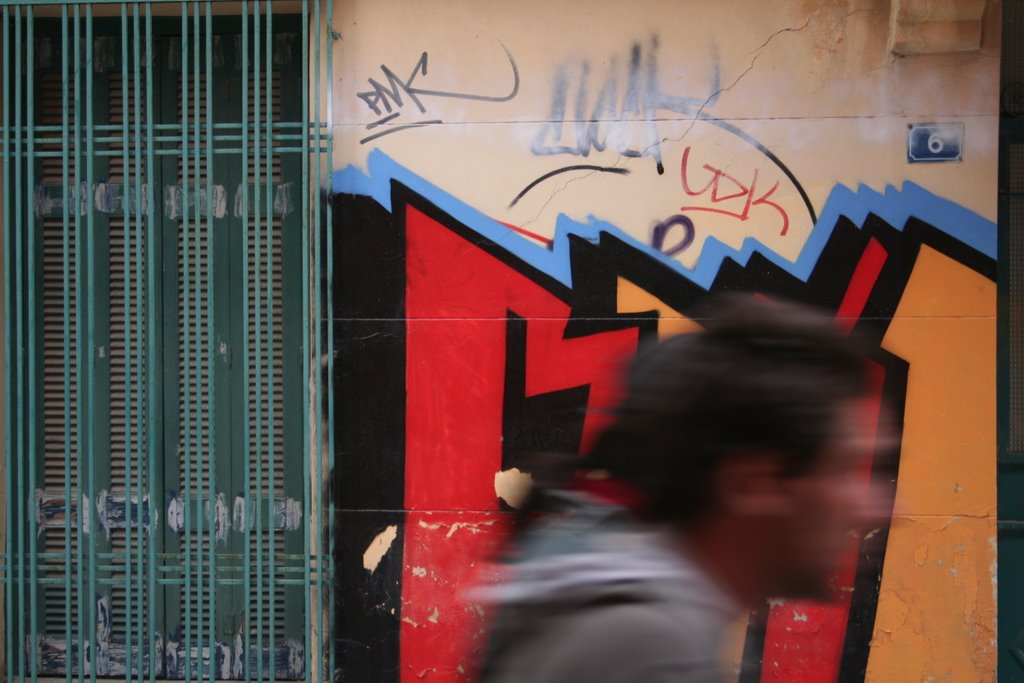
Graffiti is a kind of fingerprint. Metropolitan police officers have been known to turn up to the opening nights of graffiti-based gallery shows armed with photographs of tags in order to pin down the faces behind the art. Veteran taggers don’t need to resort to entrapment: they claim they can read off a biography from most walls. The height of a text betrays how tall the artist is; the slope of the lettering if they’re left- or right-handed; the intensity of the spray whether the can has been tilted or held at length.

Ornate styles, those where the tops of letters have a lot of flare, or which effulge with star and cloud symbols, tend to be the work of Europeans. British tags, by contrast, are normally more blunt, less affected: the can is neither pulled back or pushed forward, merely held straight to the wall. London tags are noted for their rawness: almost always simple motifs and on the small side, they are often in black and white, as those putting them up don’t have enough time for colour. In villages or small towns, it only takes one or two distinctive tags to make an artist’s name; in the capital, where competition is fiercer, there is a greater focus on quantity. The art veers toward branding: the shape of the letters, endlessly repeated across the city buildings, is as important as the words.

Pirate Texts is Sukhdev Sandhu's eighth episode for Night Haunts which launched in February 2006. Artangel Interaction invited Sandhu to record his forays into the London night in this special collaboration with web designer Ian Budden of Mind Unit and sound artist Scanner. To read more click on www.nighthaunts.org.uk.

Tuesday, September 12, 2006

My Own Private Tokyo

By William Gibson

I wish I had a thousand-yen note for every journalist who, over the past decade, has asked me whether Japan is still as futurologically sexy as it seemed to be in the '80s. If I did, I'd take one of these spotlessly lace-upholstered taxis over to the Ginza and buy my wife a small box of the most expensive Belgian chocolates in the universe.

I'm back to Tokyo tonight to refresh my sense of place, check out the post-Bubble city, professionally resharpen that handy Japanese edge. If you believe, as I do, that all cultural change is essentially technology-driven, you pay attention to Japan. There are reasons for that, and they run deep.

Dining late, in a plastic-draped gypsy noodle stall in Shinjuku, the classic cliché better-than-Blade Runner Tokyo street set, I scope my neighbor's phone as he checks his text messages. Wafer-thin, Kandy Kolor pearlescent white, complexly curvilinear, totally ephemeral looking, its screen seethes with a miniature version of Shinjuku's neon light show. He's got the rosary-like anticancer charm attached; most people here do, believing it deflects microwaves, grounding them away from the brain. It looks great, in terms of a novelist's need for props, but it may not actually be that next-generation in terms of what I'm used to back home.

Tokyo has been my handiest prop shop for as long as I've been writing: sheer eye candy. You can see more chronological strata of futuristic design in a Tokyo streetscape than anywhere else in the world. Like successive layers of Tomorrowlands, older ones showing through when the newer ones start to peel.

The world's second-richest economy, after a decade of stagflation, still looks like the world's richest place, but the global lea lines of money and hustle have invisibly realigned. It feels to me as though all that crazy momentum has finally arrived.

So the pearlescent phone with the cancer thingy gets drafted straight into props, but what about Japan itself? The Bubble's gone, successive economic plans sputter and wobble to the same halt, one political scandal follows another ... Is that the future?

Yes. Part of it, and not necessarily ours, but definitely yes. The Japanese love "futuristic" things precisely because they've been living in the future for such a very long time now. History, that other form of speculative fiction, explains why.

The Japanese, you see, have been repeatedly drop-kicked, ever further down the timeline, by serial national traumata of quite unthinkable weirdness, by 150 years of deep, almost constant, change. The 20th century, for Japan, was like a ride on a rocket sled, with successive bundles of fuel igniting spontaneously, one after another.

They have had one strange ride, the Japanese, and we tend to forget that.


In 1854, with Commodore Perry's second landing, gunboat diplomacy ended 200 years of self-imposed isolation, a deliberate stretching out of the feudal dreamtime. The Japanese knew that America, not to be denied, had come knocking with the future in its hip pocket. This was the quintessential cargo-cult moment for Japan: the arrival of alien tech.

The people who ran Japan - the emperor, the lords and ladies of his court, the nobles, and the very wealthy - were entranced. It must have seemed as though these visitors emerged from some rip in the fabric of reality. Imagine the Roswell Incident as a trade mission, a successful one; imagine us buying all the Gray technology we could afford, no reverse engineering required. This was a cargo cult where the cargo actually did what it claimed to do.

They must all have gone briefly but thoroughly mad, then pulled it together somehow and plunged on. The Industrial Revolution came whole, in kit form: steamships, railroads, telegraphy, factories, Western medicine, the division of labor - not to mention a mechanized military and the political will to use it. Then those Americans returned to whack Asia's first industrial society with the light of a thousand suns - twice, and very hard - and thus the War ended.

At which point the aliens arrived in force, this time with briefcases and plans, bent on a cultural retrofit from the scorched earth up. Certain central aspects of the feudal-industrial core were left intact, while other areas of the nation's political and business culture were heavily grafted with American tissue, resulting in hybrid forms ...


Here in my Akasaka hotel, I can't sleep. I get dressed and walk to Roppongi, through a not-unpleasantly humid night in the shadows of an exhaust-stained multilevel expressway that feels like the oldest thing in town.

Roppongi is an interzone, the land of gaijin bars, always up late. I'm waiting at a pedestrian crossing when I see her. She's probably Australian, young and quite serviceably beautiful. She wears very expensive, very sheer black undergarments, and little else, save for some black outer layer - equally sheer, skintight, and microshort - and some gold and diamonds to give potential clients the right idea. She steps past me, into four lanes of traffic, conversing on her phone in urgent Japanese. Traffic halts obediently for this triumphantly jaywalking gaijin in her black suede spikes. I watch her make the opposite curb, the brain-cancer deflector on her slender little phone swaying in counterpoint to her hips. When the light changes, I cross, and watch her high-five a bouncer who looks like Oddjob in a Paul Smith suit, his skinny lip beard razored with micrometer precision. There's a flash of white as their palms meet. Folded paper. Junkie origami.

This ghost of the Bubble, this reminder of Tokyo from when it was the lodestar for every hustler on the face of the planet, strolls on and then ducks into a doorway near the Sugar Heel Bondage Bar. I last came here right on the cusp of that era, just before the downturn, when her kind were legion. She's old-school, this girl: fin de siècle Tokyo decadence. A nostalgia piece.